Exclusive: AMD kills Wichita and Krishna
Not enough life left to launch
Nov 15, 2011 in analysis, Channel, Desktop, Finance, Microprocessors, Mobile, Rumors
SemiAccurate has been hearing that the rumors that AMD’s (NYSE:AMD) Witchita and Krishna are on the chopping block for a few weeks. Over the last few days, that has been confirmed by several different sources.
Yes, you read that right, the follow on to Brazos/Ontario/Zacate has been knifed, there will be no 28nm Wichita and Krishna. Why? No one is saying definitively, but we would guess that it is due to timing of GloFo’s 28nm SHP process. As you can see from the picture below, taken from a GTC 2011 slide, the process is set for production in mid-2012. That means there won’t be significant volumes until Q3/2012 for a chip that is due to be replaced at the end of 2012.
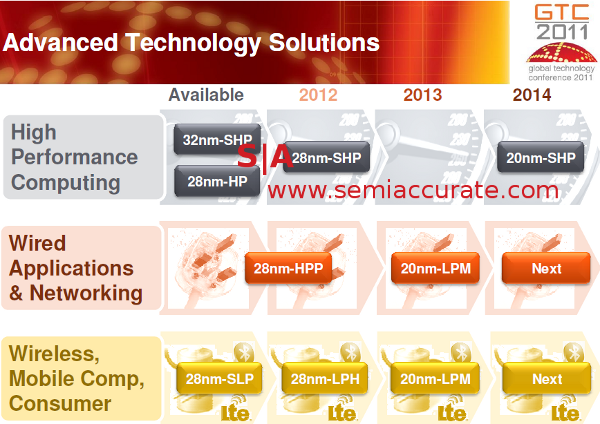
GloFo process roadmap
This means that Wichita and Krishna would have a shelf life of ~6 months, likely less. No OEM is going to pick that part up and design machines around it for such a short time, it isn’t financially viable. Brazos is already set for a mild tweaking to get a little more speed and little less power use, so that will have to hold the fort for an additional six months.
If things go well, the additional resources needed to bring Wichita/Krishna to market will be diverted to the successor, and that will in turn be pulled in. This may lead to the post Wichita/Krishna part in Q4, maybe a bit before, and all will be happy. If not, things go pear shaped, people leave, and OEMs send impolite emails to their sales contacts. We won’t know which way it goes for a bit longer, but either way, the successor to Brazos is now quite dead.S|A
93 Responses to “Exclusive: AMD kills Wichita and Krishna”
Trackbacks/Pingbacks
-
-
Nov 17, 2011
[...] acuerdo a Semi Accurate, AMD se habría “cargado” a Wichita y Krishna de la hoja de ruta de sus APUs para [...]
-
-
Nov 17, 2011
[...] сообщает ресурс SemiAccurate, ссылаясь на собственные осведомленные источники [...]
-
-
Nov 16, 2011
[...] Glaubt man einen Bericht auf semiaccurate, sind die Nachfolger der recht erfolgreichen Netbookchips C-30, C-50 & C-60 sowie der [...]
-
-
Nov 16, 2011
[...] Wolfgang Andermahr Quelle: SemiAccurate « Vorige News | Nächste News [...]
-
-
Nov 16, 2011
[...] Wichita e Krishna. È questa l’indiscrezione raccolta da varie fonti e pubblicata dal sito SemiAccurate. La piattaforma Deccan dunque non verrà più realizzata. Il chipmaker di Sunnyvale continuerà ad [...]


AMD bringing good products out to the market is now null and void because they killed Wichita and Krishna. Trinity is not going to be all that good because the only that will change is that clock speed. The IPC will decrease because of the crapdozer architecture that Trinity will use. I don’t think power consumption will go down at all. I would love to be proved wrong but I don’t think that is going to happen.
i guess well have to wait and see, but i am amazed that fusion was supposed to be so successful bec i havnt seen many fusion laptops/netbooks we have only 1 netbook with a fusion processor where i work , bulldozer seems to be selling well but we dont have many 8150/8120s in the uk
Clock speed and power, you can’t get one while the other is a wall.. and about IPC might not be stellar, but fix the some easy issues and give it over 4.0Ghz(base) and actually BD can beat SB Face it!
And this isn’t piledriver
http://www.cpu-world.com/CPUs/Bulldozer/AMD-FX-Series%20FX-8170.html
has hit wikipedia laready
http://en.wikipedia.org/wiki/AMD_Bulldozer
300 Mhz more in short notice, very good achievement.. and there is a 8120 at 95W
So this high power low performance, is plain wrong, can’t judge a product potentiality by some less optimal first releases.
This information is nonsensical rumours, Charlie.
The REAL reason Wichita/Krishna is canceled, is because the Chief engineer left, taking the other engineers with him. They all went to Samsung Semiconductor.
If you don’t believe me, look up Brad Burgess.
http://www.linkedin.com/pub/brad-burgess/26/aa9/93
The entire future of the Bobcat line is dead. There’s no engineers working on it.
AMD will be releasing refresh models (speed bumps) for 2012 under some re-labelling. Search for E1-1200 and E2-1800 models.
If that is true then AMD is in BIG trouble. Bobcat was their biggest seller and without it they are done for.
This is looking like more and more of a nightmare for AMD.
Engineers leaving. A guy from Lenovo is now controlling them. Lenovo, a company whose lines of laptops are 100% intel/nvidia, with the exception of 3 sku: the Zacate based x120e, and two sku of the Edge line featuring 50% castrated dual cor Llanos.
They might as well ask some Intel employee to become their CEO…
So there are no engineers working on this stuff, and your evidence is the LinkedIn profile of one person. Compelling stuff. Not.
OF COURSE PEOPLE ARE LEAVING, AMD IS LAYING PEOPLE OFF.
Brad Burgess: Formerly Chief Architect – Bobcat (a low power x86 processor core), left in August for Samsung
How about two more?
Jim Mergard: Formerly VP Chief Engineer at AMD, left for Samsung (time unknown)
Frank Helms: Formerly System Architect at AMD, left for Samsung also in August
Maybe they saw the writing on the wall, two months *before* the layoffs.
“AMD will be releasing refresh models (speed bumps) for 2012 under some re-labelling. Search for E1-1200 and E2-1800 models.”
that will be enough.. till the upto 1 module + GPU (piledriver) that replaces it
the rest wont be missed.
Isn’t AMD’s bobcat/zacate and their successors made by TSMC? But they are having trouble as well. I wonder if AMD is going to make the successor from 20nm instead of 28nm.
OK. So AMD is now too poor to manufacture successors to Zacate?
I’m sure we, the consumers, will be thrilled with this.
With a bit more bad luck, they might even become too poor to manufacture wichita’s successor as well?
Long live Zacate?
Or maybe it’s design problem? Some huge flaw that causes it to be scraped?
Or it’s a problem with global foundry manufacturing?
There is a difference between being “too poor” and having good judgment regarding a dynamic marketplace.
Product cancellation means something went wrong. That means bad judgement.
And this is yet another reason why AMD will never achieve any kind of mind share among enthusiasts. They keep sell their old stuff while never releasing anything new.
Their fanboys might applaud this idiotic tactic, but they should also be reminded that this complacency is the reason why Athlon 64 got raped by Core 2.
Speaking of fanbois… when Intel cancels it’s OK but when AMD does it, something went wrong? REALLY? Have you looked up the word denial?
Perhaps you’ve heard that AMD hired a new CEO by the name of Rory Read about 75 days ago? Maybe he has something to do with the change in Biz strategy/direction?
How can you hate on AMD for being complacent when they are attempting to bring superior products to market?
Your comments make no sense.
I don’t know about you, but to me Krishna/Wichita represented AMD’s best chance to beat Intel in any market segment.
Cancelling that is messed up.
Now, if AMD cancelled any Bulldozer derivatives, I would applaud. But hearing about Krishna/Wichita getting cancelled was a WTF moment.
Yeah, through the eyes of an Intel fanboy, cancelling anything is nothing but good news. The problem is that if the product can’t be produced in reasonable quantities on a reasonable schedule for a reasonable amount of time, it might actually be a better decision to cancel it and work on the next product.
And through the eyes of an blind Intel hater, anything Intel does is bad and pathetic, and anything anybody else does is good and pure.
“” I don’t know about you, but to me Krishna/Wichita represented AMD’s best chance to beat Intel in any market segment.”"
Really ?
Imagine a CPU with only a steamroller module (2 cores- better cores than now) and a GPGPU better than anything Intel can make, all well under 20W ?
Why is any need to maintain another design ?
… when you can tweak an existing one, and an AMD module is proved can be the most efficient ever perf/power for a 2 core design… one 1 module + GPU can even be smaller than a bobcat style CPU with the same GPU… and more performant..
… for the same markets that AMD is winning now, namely down to tablets, can see AMD lose with this ?
in my opinion the core2 was over hyped , at the time i could barely tell a difference between my sepmron 1400 and an e280 , i owned a q6600 and i prefered my athlon x2 6000 and regrated uprading to the intel cpu
(i didnt do any do benchmarks but im refering to general use including gaming)
1 thing im amazed about is the fact that (i know intel have about 7 fabs and 2x the r&d budget of amd) intels is producing, despite the fact that amd is using 2 of the biggest companies (tsmc + glfo), quality silicon that others are not even comming close to matching
Really sad because a win 8 release asiden the bobcat upgraded release would’ve beeb a huge win.
ADVANCED MICRO DISASTERS!!
I’m switching over to the Blue Team
I bet you were already in the blue team, so no switch required.
i thought the whole big thing with brazos was that they took a die size / performance / wattage hit in favor of using general design rules that make the chip portable to different processes and different design rules. which makes me wonder why didn’t they change plans and go to TSMC?
6282 SE
8/16
140W
2.6/3.0/3.3
$1019
thats latest, beats intel by $300, 1 Ghz/s slower though, 10 more cores. for top ender.
drashek waffle server….
GF? SHP ?
You surely mix sth up here. I cannot believe that Krishna / Wichita were planned for 28nm SHP@GF. Not far ago, GF didnt have a SHP process at all. AFAIK, that process is only planned for Steamroller based Bulldozer CPUs, tuned for high-clocks. You dont need that for Bobcat style processors.
The Bobcat family is so far produced@TSMC. It is low-power, you do not need an SOI process for that. Thus, I assume that Krishna/Wichita were designed for TSMC’s 28nm process, too.
So we have to find another explanation. I would say: Save money, by canning these chips and pull in the Kerala APU. Allt hese designs are fully synthesized, more or less easily to handle, it already worked with Ontario.
Another reason could be wafer orders @TSMC. Booked wafers for the APUs could be changed into GPU / GNC wafers. Who knows, maybe AMD thinks they have a winner and expect to sale more.
Sometimes Charlie purposely screws up some information to try to catch plagiarists.
Or Charlie just makes things up.
OEMs run on tight margins. A six month shelf life vs their ROI? It’s a risky move if they go for it.
I read Rory’s “will Krishna/Wichita make a buck?” as the main question for a go no-go decision.
You mean Kabina APU – Kerala is the platform.
Digitimes: “In June 2012, AMD is set to launch Deccan, featuring Krishna and Wichita-based APUs and will upgrade to Kerala featuring Kabini-based APUs. With the upgrades, the overall performance and power consumption of AMD’s platforms are expected to see an extraordinary improvement, allowing AMD to compete against Intel’s Ivy Bridge platform in 2012 and Haswell platform in 2013.”
I have no idea where Digitimes got the idea that Krishna would be competing against Ivy Bridge, and Kabina against Haswell.
Anyway, all I can think is that Kabina is proceeding very well and might even be ready for mid-2012, and as that is the timeline for Krishna/Wichita, keeping them on would seem rather silly.
WHAT PURE DRIBBLE. The tiny, low power ‘stars’ cores built so successfully at TSMC, were due to first get a slight improvement at TSMC, then switch (hohoho) to Global Foundaries, so they could be re-purposed to that quality CPU magic known as the Bulldozer core.
Everybody, but the people running this site, have noticed that Bulldozer is a disaster worse than Netburst. The idea that AMD should continue with its plans to replace all their CPU designs with Bulldozer cores is completely moronic, and AMD realises this.
So, what is happening? Well, since Bulldozer 2 (the one with the GPU built in) is designed, tested, and almost ready for launch, AMD is allowing the Bulldozer design team one last chance to prove the worth of the architecture, while at the same time cancelling plans to kill off the ‘stars’ architecture as soon as possible.
Far from moving all production from TSMC, AMD actually has an incentive to move MORE CPU production there. Unlike many chips built at TSMC, x86 CPUs have insanely large profit margins. GF may, in reality, be still connected to AMD at-the-hip, but AMD needs to make successful product any way it can.
If the saga of Netburst never happened (Intel returning to the Pentium3 design, after 2 bad Pentium4 designs released, and even more planned/designed before cancellation) AMD would, undoubtedly, stick with Bulldozer, trusting that things could be made better. However, the Netburst saga is a living lesson in how even the biggest companies can say “no, you are wrong” to their most senior engineers, and give the (much) smarter ‘young turks’ their time in the sun.
The Zacate designers delivered big time. The llano team too, in a smaller sense. The Bulldozer people have not one single example of good engineering in the Bulldozer architecture, despite the fact that it replaced a CPU architecture (stars) that had many fixable deficiencies compared to Intel’s last few families.
With the coming switch to ARM, and the (slow, lingering) death of x86, AMD can afford to NEVER have a new CPU architecture replacing ‘stars’. 4-core Llano+ @ 3Ghz+ will be all 99.9% of potential x86 PC users need until the x86 PC market fades.
And all the home user could ever need from their PC is 640k RAM
That’s right. Guess who said that?
So take another guess that in 5 years Llano will be like … well Pentium3?
Which is great, maybe we’ll have enough computing power (in the same envelope) so they’ll discover the cure for cancer :)
Or at least how to manage warp engines :)
Current computers are waaay tooo slow
Hardly… Bulldozer based Opterons perform admirably in case you haven’t bother to read the reviews. Llano is also doing VERY well and Trinity will build on that.
AMD needs to pull Piledriver ahead and crank up their FX desktop CPU performance. Then they will have excellent products in all X86 segments that they can build on.
You’re a fool if you think x86 is going anywhere.
In fact it’s ARM that’d going to suffer a slow, lingering death, starting with x86 cell phone chip taking over the market, stock price crashing after a revenue drop, couple of executives leaving as their options became worthless…
ARM cannot compete with x86 because ARM designs can’t use Intel’s fabs. It’s as simple as that.
So let me get this straight. The guys who have been eating Intel’s lunch the last 3 years whilst not using Intel’s fabs are going to suffer a slow lingering death because they now don’t have Intel’s fabs?
Sorry, ya got me there.
Or did you mean x86 itself is worthless and only Intel’s fabs matter?
ARM isn’t eating Intel’s lunch. ARM is nowhere in the PC business, and will not be in the next 3-4 years, because ARM performance isn’t good enough.
Meanwhile, cell phone business has always been ARM’s lunch, but that’s something x86 will start chewing on shortly.
1w x86 is too much, where are the mw x86 chips coming from then eh?
1W and finishing the job in a second is far better than 500mW and finishing the job in four seconds.
Yeah right. As long as they’re committed to x86, it won’t matter what kind of fabs Intel has in the low-power market.
The supposed X86 disadvantage is smaller than you think.
Did you notice how 28/32nm A15 is only 10% more power efficient than a 40nm A9? The process node advantage alone should’ve made it some 20% more efficient, let alone architectural advantages.
Why was the improvement so poor? Because ARM has to sacrifice efficiency to improve performance towards x86-like range.
Once ARM performance equals x86, its efficiency advantage is gone. Then, Intel’s fab advantage will crush ARM.
Sorry – this is inevitable.
ARM can move upward. Maybe Intel’s fabs will be too much to contend with in that market. But the point is that x86 won’t be able to move downward to compete in the low-power market, at least not any time soon.
“Did you notice how 28/32nm A15 is only 10% more power efficient than a 40nm A9?”
That’s nice, but we’re comparing ARM to Intel, not ARM to ARM. In the low-power market. Try to stay on-topic.
1) ARM can move upward, but sacrifices its efficiency and ends up losing to x86 in the PC market.
2) Low-end cellphone market: X86 will IMPROVE efficiency when scaling down performance (just like ARM loses efficiency when scaling up performance). And that’s without the fab advantage. ARM will be dead there.
3) High-end cellphone market: AMR will LOSE efficiency, and won’t be able to compete with x86, especially because of Intel’s fab advantage.
How hard is it for you to understand? ARM has looked more efficient only because it’s a low-performance chip. Once x86 and ARM are equal in performance (be it high-end or low-end), the architectures will end up being roughly equal in efficiency.
And at that point Intel’s fab advantage will crush ARMs.
But in the end ARM will be cheaper than x86 since there’s more competition between ARM’s licensees and ARM’s business model doesn’t require fat margins (higher prices) in order to stay ahead in the FAB game like it’s the case with Intel. And x86′s compatibility with old windows software doesn’t mean much on phones due to small displays and touch interface instead of keyboard/mouse.
1) I don’t care. Because that wasn’t the topic of discussion anyway. Do you have a 2-second attention span or something?
2) “X86 will IMPROVE efficiency when scaling down performance” Please show your work.
“How hard is it for you to understand?”
It wouldn’t be hard to understand at all, if you could provide something, ANYTHING at all, to substantiate your claims. Look at the lowest-power x86 CPUs out right now. They suck. My Hummingbird-powered phone feels faster than an Atom chip, and it uses WAY less power. I don’t see how you expect Intel to make these monumental gains in efficiency that are necessary to leapfrog ARM any time soon, nor do I understand why you don’t expect any of ARM’s engineers or their licensees to actually improve the efficiency of the ARM architectures over time.
Furthermore, the fact that you insist that fab technology will be nothing but positives for Intel tells me you don’t know much about semiconductors.
Computing power is getting to the point where we already have plenty of power, so focus will again shift to further gains in efficiency. ARM is already ahead of Intel in that respect. Process technology advantage isn’t the savior you seem to think it is. Besides, even with ARM chips a node behind, the larger amount of competition means prices for ARM chips will drop to the floor, while Intel will have to lose money to push x86 into a market that doesn’t want it.
You’re all-around clueless. I think you just like hearing yourself talk about Intel.
1) We’re both in this discussion – you don’t get to unilaterally decide what the topic is.
2) Atom was much more efficient than the “full-size” CPUs at the time. Also, did you miss the x86 research chip shown in the IDF that was powered by a postage stamp sized solar panel?
If ARM efficiency gets worse when performance is increased (A9->A15) and gets better when performance is decreased (A9->A7), what exactly makes you say this cannot be the case for x86 as well?
Your Hummingbird-x86 comparison is invalid. To make a somewhat valid comparison, you should make sure they both have the same OS and supporting hardware (phones/tablets use flash, netbooks use sh*tty HDDs). Once an x86 phone comes out (H1/2012), you can make a valid comparison. My prediction is that x86 will crush ARM in performance, and is only slightly more power hungry.
Charlie himself has said that even the Moorestown “tablet-phones” he tried were the fastest things out there.
TSMC silicon isn’t free; the ARM customer products have to support TSMC’s process development and margins. If Intel really wants to compete with price, they can cut their margins to zero if they want. ARM licensees cannot – the TSMC fab margin (and ARM’s ever-increasing royalties) will always be there. And I know more about semiconductors than you think.
Sorry, but you’re the clueless one. It’s not my problem, really – you can live in your ARM dream world if you want. I’m just trying to help you get prepared for the future, so you won’t be massively disappointed.
1) If you’re going to respond to me, then I’m going to ignore the extraneous points that you make that have nothing to do with the comment you’re replying to.
2) I’m sorry, are you talking about shipping silicon? No? Once again, I don’t care.
“what exactly makes you say this cannot be the case for x86 as well?”
Gee, I don’t know, maybe the fact that these are different architectures.
“To make a somewhat valid comparison, you should make sure they both have the same OS and supporting hardware blah blah blah…”
Nothing like real-world examples, huh?
You haven’t supported any of your “predictions”, even after I specifically asked you to do so, so I can only surmise that you have factual basis to make the claims you have made.
*don’t* have factual basis.
x86 will crush ARM ?
I used to have that opinion to, but one factor to take into attention is this systems are client, graphs and media are getting of utmost importance.
What about something we can call a GPGPU on a smarthphone?
So who will crush who depends on that factor, performance wise. If Nvidia is there, and AMD is knifing bobcat to sell GPU to ARM vendors(integrated designs- FSA/FSAIL fits so in hand) then INtel has neither the chance to play with performance, nor cost cause the tri-thing is ubber expensive, neither FAB in general if they stay at “bulk” while- ARM is going UT-SOI… which makes it at power effic ARM given a severe beaten to x86
1) I don’t care. Because that wasn’t the topic of discussion anyway. Do you have a 2-second attention span or something?
2) “X86 will IMPROVE efficiency when scaling down performance” Please show your work.
“How hard is it for you to understand?”
It wouldn’t be hard to understand at all, if you could provide something, ANYTHING at all, to substantiate your claims. Look at the lowest-power x86 CPUs out right now. They suck. My Hummingbird-powered phone feels faster than an Atom chip, and it uses WAY less power. I don’t see how you expect Intel to make these monumental gains in efficiency that are necessary to leapfrog ARM any time soon, nor do I understand why you don’t expect any of ARM’s engineers or their licensees to actually improve the efficiency of the ARM architectures over time.
Furthermore, the fact that you insist that fab technology will be nothing but positives for Intel tells me you don’t know much about semiconductors.
Computing power is getting to the point where we already have plenty of power, so focus will again shift to further gains in efficiency. ARM is already ahead of Intel in that respect. Process technology advantage isn’t the savior you seem to think it is. Besides, even with ARM chips a node behind, the larger amount of competition means prices for ARM chips will drop to the floor, while Intel will have to lose money trying to push x86 into a market that doesn’t want it.
You’re all-around clueless. I think you just like hearing yourself talk about Intel.
Sorry – I gotta continue this here, because SA doesn’t let me respond to your other comment (bad site formatting).
1) You talked about “low power”. You don’t get to unilaterally decide what ‘low power’ means. Everything I said related to “low power.” Of course, you can choose to ignore my comment, but that means you also lose the argument.
2) Shipping silicon..? Seriously? Ignoring the (near) future alone renders your logic dead. You don’t think things become different in the future? You yourself are referring to the future in your previous comments, such as this one: “ARM can move upward. Maybe Intel’s fabs will be too much to contend with in that market.”
Or, do you REALLY want to keep this discussion in the CURRENT state of cell phones (which will be valid for, what, a month?)? Then yes, ARM wins Intel loses, and all is well.
You’re beyond clueless.
Also, just to make sure we’re on the same page, there is no “shipping silicon” with ARM cores that can in any way oompete with x86 in anything but the lowest-of-the-low end.
I have plenty of factual bases to explain my conclusions, but to understand it all takes some actual understanding of the semiconductor physics and circuit theory behind it, and you don’t seem to have it (in spite of YOU claiming I don’t).
Unless you can prove that you have enough understanding of this stuff, this discussion is over.
1) Say ‘unilateral’ one more time. Maybe I’ll start to care then. Keep trying to derail the conversation, since you’re obviously no good at making logical arguments.
2) That little tech demo has nothing to do with any silicon that will be shipping in the near future. Sure, my literal words could have been worded better, but the point was extremely clear to anyone of reasonable intelligence, provided that they’re not blinded by Intel fanboyism.
The tablet market isn’t low-end. Why aren’t they shipping with Atoms? Because Atoms suck, that’s why.
“I have plenty of factual bases to explain my conclusions, but to understand it all takes some actual understanding of the semiconductor physics and circuit theory behind it”
No, see, to understand it, you’d actually have to provide it. I can’t understand what doesn’t exist. You need to quit wasting words on semantic arguments and actually support your opinion.
Alright, I have to say I do agree with you for the intel fab and process advantage. HOWEVER, this won’t prevent someone else making a better chip than intel! The hypothetical winner would have disavantage VS intel: an older node, much less volume, less money behing the chip…
x86 stealing ARM market: Won’t happen “shortly” really. Intel made atom. But it’s purpose never was to get it to fit into smartphone space. It filled a void : netbook, some embedded design. Now we know a scaled-down x86 didn’t crush ARM. It’s best “feature” was it’s x86 arch thus compatible with windows. Well guess what? Windows 8 will run on ARM, spelling doom for atom?
Next point: ARM performance isn’t good enough.
Yes indeed, you are right. And I don’t think the A15 cortex will crush sandy-e either. But the gap with shrink. I don’t know what will be the TDP of A15 but we can bet under 20W…
I think the upscale will be in ARM advantage which may threaten x86.
Anything performance, efficiency or even cost related, Intel will be the winner (and all that is coming from the fab advantage).
Where Intel could completely fail, though, is features.. like lack of integration compared to others (multiple chips when others have only one), missing some important functionality like USB3… Qualcomm is able to integrate even their radio modems onto the same chip – Intel can’t.
We haven’t really seen a scaled-down Atom yet. As far as I’ve understood from the rumors, that was supposed to come inside a Nokia MeeGo phone, but it didn’t materialize. Intel is still talking about Medfield, saying it will be in phones next year. I think then we’ll really see what a scaled-down Atom looks like – how much performance they had to sacrifice when cutting down power consumption.
I’m most interested in seeing a 22nm cellphone Atom – with trigate power efficiency advantage, it could end up being a superchip.
Go Intel fanboy, GO!
Nobody in their right mind wants to see an Atom-powered cell phone.
ARM monopoly is a good thing, right?
Dumbass.
Yeah, because there’s NO competition in ARM chips! Idiot.
So let me get this straight: Atom-powered phones are a good idea, not because the product is good, but because it’s not ARM. So ARM is bad because ARM is ARM, and Intel is good because Intel is not ARM. Your logic is amazingly sound! I want one of these Atom-powered phones NOW!
You have no clue what you’re talking about.
There’s no such thing as “Bulldozer 2″. You’re talking about Piledriver, which doesn’t have a GPU, because it’s an architecture, not a chip.
Don’t talk gibberish! BD2 ES run like a charm.
“The tiny, low power ‘stars’ cores built so successfully at TSMC, were due to first get a slight improvement at TSMC, then switch (hohoho) to Global Foundaries”
uhmm ya i stopped reading here. stars was never manufactures at TSMC. the only CPU made at TSMC is brazo/bobcat.
“… Far from moving all production from TSMC, AMD actually has an incentive to move MORE CPU production there. …”
AMD has a significant stake in GloFo (about 34%) and has equal voting rights with ATIC. AMD’s incentive is to go with GloFo when possible. It really is a win-win.
(NB: ATIC wants to buy out AMD’s remaining shares.)
If Charlie had been writing a review of this and it had been an Nvidia story. To hot,to big….
Well, that is probably his stance, but at least we do get correct stories, even if at times they include too much bashing or too much praise. The only reason I am still coming to this website because even if with a lot of gripe, they do give the credit where it is due.
Another Major Disaster…
Umm, no.
Think Northern Islands …
Also, BTW, Brazos is STILL sold out …
processors coming to maturation, except need 4 game cards with 2 gpu each, not that done.
seems pothole has emerged in roadmap. sb-e was bad ’nuff. engineers taking All Day Nap. save today, lose tomorrow. where are 3D tranny Beds, for restful Sleep. at east chiggers are dying off.
drashek flukeologist.
Have you ever considered learning a second language such as English?
Why don’t you spare us your worthless comments and learn to respect your betters? You ain’t shit compared to Drashek.
This. Ben doesn’t even qualify carrying Drashek’s shit.
Lay off drashek, he’s the smartest and most insightful of us all, and he’s a joy to read.
Ben, have you ever considered being less condescending?
understand that drashek’s comments make a lot more sense than your peurile drivel about nothing on topic.
nuff said
What a story, Drashek. Anyway, how’s your sex life?
I wanted to buy one of those. Damn!
Let’s just hope their follow-ups are bigger bang for the buck and at the least on schedule!
Too bad for AMD because their low power products make up most of their sales. Without 28nm to help AMD ARM and Intel will walk all over them. It is the beginning of the end for AMD.
That has been said like millions of times, but yet we see every quarter AMD surviving…
One wonders how Charlie would have written this article had it involved Nvidia.
Poor planning?
This is actual good news and the best way out of the current situation. Promises rewards come 2013. Plus Bobcat is arguably the most succesful AMD processor line currently anyways. So I don’t see what being nVidia could have changed here.
Yeah, like if KalEl+ was killed..
Well, at least you have to respect the man’s consistency in bias.
Point taken DM.
Sad to say, those little APUs are one of AMD’s better efforts in the market lately.
The way G/F and TSMC are going… AMD could come up with the greatest CPU designs in the history of the universe but Intel will win merely because it can actually manufacture things!
And market them. The average Joe has probably seen those colorful Intel commercials. But 90% of everyone I know doesn’t know who AMD even is, and 98% don’t know what they make.
Good sign, something AMD have done to much is pour too much time into very short term products either on a dead process or on a late process too close to the “next gen”.
Its not really AMD’s fault, its hard to plan a new chip for a new process then watch the process slip but its something AMD do need to get better at.
Thing is how much money/time was poured into Wichita/Krishna already, and how much could have been saved if someone realised this a year ago?
With Piledriver ready to go in Jan for trinity, why on earth are they launching Bulldozer in October and Piledriver in non trinity form basically a year later and over 6months after its available in Trinity?
Its what Nvidia is facing now with Tegra 3 and apparently 4, too much time on a dead end product which is delaying the next gen, which means the next gen is late and fighting better competition.
Because not everyone wants to buy an APU that includes both CPU and GPU.
What has that got to do with anything I said, or the article. Not everyone wants a APU, sure, I was saying, Piledriver, the 2nd version of Bulldozer is about to go into full scale production in an APU. So the CORE is ready, tested, validated and supposedly faster.
The piledriver stand alone none APU version isn’t launching till, AFAIK Q3 2012. Had they dumped Bulldozer and focused on Piledriver, much like they are now doing with Wichita/hari, then they could have bought forward the NONE Apu Piledriver a few quarters.
I’d prefer a “delay” from October till January and have Pildriver octo cores rather than Bulldozer. AMD probably would have preferred that, and most enthusiasts would have as well.
The question is, did Llano getting ported to 32nm delay Trinity as well, or did AMD get a little lucky and that caused Trinity to come with Piledriver cores rather than Bulldozer cores.
I’m not blaming AMD, nor Glofo or TSMC. Process’s are getting harder, look what Intel have done recently. A huge chipset screw up, SB-E on a VERY mature process is missing a bunch features they can’t get working. 22nm is seemingly delayed at least a little.
Intel has more to gain from throwing money and people at a problem, TSMC would lose most of their profits if they just threw an extra few billion at R&D to get something done quicker. The margins on production I would assume were FAR lower than the margins Intel make on their cpu’s.
Intel has the same problems, just more resources and less downsides to spending through them. Up to what 65nm was almost “easy”, pretty much every process from here on in will be exponentially harder to get done right.
Realistically AMD’s seeming move to far more frequent, and smaller step architecture improvements should help. Small enough to be easy to deliver on time, and to make new process delays less problematic.
I don’t think Llano was supposed to be 32nm. I think that happened because it was clear that Bulldozer was going to be late.
What if 28nm SHP is SOI ? .. half nodes hasn’t been done in SOI yet, but never too late to start. So the “considerable” delay.
The point is, for this Super HP-> at least super must mean something;.. 20nm is much probably UT-SOI, i suspect this tests with an ARM core where made at GF part of the alliance http://semimd.com/blog/2011/02/10/partners-test-utb-soi-for-mobile-systems/
..and gorgeous results…
Meaning 22nm SHP gets the knife, after all most probably only AMD would use it.
28nm SOI.. but not yet UT, would prepare, or has been preparing the way for the considerable hurdles of UT-SOI at half node 20nm… a process that most probably everyone interested in SHP at GF will use, including ARM.
Doesn’t make any sense to maintain a 22nm SOI that is not UT(probable) for 1 costumer, and another SHP process for the same SOI at 20nm, but that is UT-SOI, with much more performance than the former, and both about the same time(or close)… at least to me it doesnt.
In that case Trinity at 28nm SOI(the 32nm version taped out ions ago).. might actually had come up with the numbers in some core test good enough for netbooks and even tablets… cant see another reason to knife krishna and whichita after tape out.
Smarthphones AMD has seen the light and droped.. its ARM allover for now.. actually with FSAIL it might be that some AMD GPU ends up in those ARMs.
there wouldn’t be either Piledriver 8 core in January… at least some dig and cant find any date for Vishera
what would you get for sure is FX-8170 3.9Ghz/4.5Gz-T.. and perhaps a 4/4.6 Extreme perhaps before xcmas.. or January.
Mhz will pile up for sure for current BD, it will mitigate a lot, Vishera probably only by end of 2012 28nm SOI ? lol…
Sorry, doesnt make sense, even more if 22nm were FD-SOI, and then have 6 months later a 20nm the same… maybe 22nm got the knife… even if not, by Krishna and whichita gone most roadmaps out there are trash.