Southern Islands, Kepler, and Apple’s A6 process puzzle outed

It all makes sense now

Jul 19, 2011 in Chips, Graphics, Microprocessors, Mobile, Rumors


TSMC - logoThe final piece of the TSMC 28nm HKMG process puzzle was put in place at SemiCon last week, it now makes sense. Chipworks got ahold of a Xilinx Kintex-7 FPGA, and it revealed a few secrets on the operating table.

If you recall, AMD is on track to put out Southern Islands chips much earlier than most people, SemiAccurate included, expected, possibly even this quarter. The real question is what process they are going to make it on, the TSMC 40nm SiON or 28nm HKMG? 40nm would be big, hot, and limited, think volcanic island more than Southern, while the 28nm SHP HKMG process wasn’t supposed to be ready until late Q1, best case. The short story is that Southern Islands is very likely not on either one.

That leaves the 28nm SiON aka 28nm LP, something that may be viable for a low power ARM SoC, but not a high power GPU. SiON at these geometries is far too leaky. Enter the good folk at Chipworks, and the poster they had at their SemiCon booth. They had just finished taking apart an FPGA based on a 28nm TSMC process, and guess what they found? HKMG. Sort of.
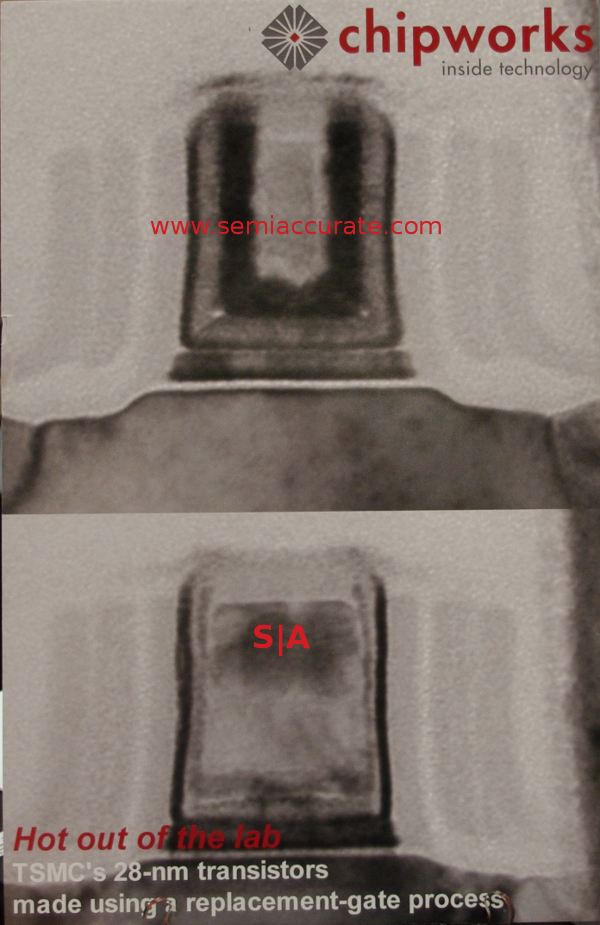
Chipworks_TSMC28_poster

Cluetrain hits at Semicon

The short story is that there is another process, and one that is not talked about much, 28nm HPL, or 28nm low power with HKMG. That is what Xilinx uses, that is what is likely in Apple’s chips, and that is what AMD will almost assuredly use too. If you want all the details, the Chipworks blog post on it is here, and you can buy the report here. Low power does not necessarily mean what most people think it does, just that the process is tuned for different sweet spots than the high performance process.

Our sources have been saying that the TSMC 28 HP process is not doing well for a while, and checks before Semicon confirmed their stance. Given the large difference between the two processes, SiGe being the likely one, it looks like HP is still somewhat problematic.

What this means for the GPU set is pretty simple, it is better than the 40nm SiON process, but not as well suited for the segment as the 28nm HP process would be. If you can use it for your chip, and AMD looks like they can, then you are not going to wait for the HP process to come out some six months later.

Given the late Q1, maybe, time frame for Kepler, it looks like that part will be on 28 HP. One related point, low power tends to mean lower clocks, and Nvidia runs their shaders at 2x the base clock, in the neighborhood of 2x what AMD runs theirs at. This may be the key differentiator that enables AMD to use 28 HPL while Nvidia’s architecture may be unsuitable.

Short story, AMD is coming out with Southern Islands soon, Nvidia and some lower end SI parts are probably gated by TSMC’s 28 HP process. We know why Q3 is going to be an exercise in pain for Nvidia, and if the information above pans out, Q4 is shaping up for a repeat. Thanks to Chipworks, we now know how the pieces are lined up.S|A


Tags: , , , , , , , , , , , , ,

65 Responses to “Southern Islands, Kepler, and Apple’s A6 process puzzle outed”

  1. Jonny Bravo Jul 23, 2011 at 1:51 am #

    Low performance process will most probably produce really nice low power Laptops/Notebooks chips.

  2. Avro Arrow Jul 22, 2011 at 8:32 am #

    This could carry significant risk for ATi. If they go ahead with this process that isn’t as suited to high-performance GPUs as the HP process which will be out 6 months later, they’ll be setting themselves up to be completely trumped by nVidia who will no doubt use the HP technology in their next iteration of graphics. I think that AMD should put the next ATi generation on hold until this process is ready, or at least hold off on the high-end parts that will need it and instead focus on the release of Zambezi which is far more vital at this time considering that they are pretty much neck-and-neck with nVidia but a far distance behind Intel. This process will most likely be excellent for Trinity but I wouldn’t want an HD 7870 based on it. It would be better as far as power consumption is concerned but it’s performance would be badly hampered.

    • nuance Jul 25, 2011 at 10:24 pm #

      money is in the mainstream (mostly laptops) where power is now becoming more a concern than just raw performance.

  3. thomasxstewart Jul 20, 2011 at 6:24 pm #

    .
    btw pOSTCARD LINK IS sOLD aT nATIONAL pARK mUSEUM sHOPS nATIONWIDE, nEW MEXICO np ALSO sELLS tICKETS FOR aCTUAL aTOMIC BOMB TEST TRENCH iN wITH. uRANIUM SAMPLE iS hERB, sO gO fIGURE.

    give me some loving, my feet Hit floor, My head Goes off, give Me some loving.Electric Cho. Always my break, rock ‘n roll.Diplomats Way. Rockin’ Love Way.Nude Light On, always Roll.

    in 2 years after finfet, amd fabs might catch up, if get work order, so far no Hyper thread, so…..BTW thats why 4 core intel races 8 core amd, both 8 threads.

    drashek look out Window & See My Loves Marching Feet.

    • TechDud Jul 21, 2011 at 4:32 am #

      no shouting, please. it strains the silicon, you see… :D

  4. brad Jul 20, 2011 at 11:26 am #

    if true, i wonder how hard it would be to migrate from one 28nm to another?

    also, i wonder if this means some of AMDs chips will be super lower power? in the same token, chips above that sweet spot might be super high power?

  5. PorscheDan Jul 20, 2011 at 7:29 am #

    Altera has TSMC 28nm HKMG HP silicon and it is doing fine. Nvidia too. Your info is incorrect.

    Also, Apple A5s are not TSMC. A6s will use the new TSMC 28nm HKMG M process. M is for Mobile.

    Sorry Charlie. Maybe you should visit Taiwan sometime rather than scanning tabloid tech blogs.

    • Vizeroy Jul 20, 2011 at 2:35 pm #

      If Nvidia is doing fine, then why did they postpone the Release of Kepler by 1Q?

      I’d like to have both kompeting each other and not chasing.

      On the 5870 I was lucky to get one at the release price.
      Very shortly after that, the prices went up and through the roof.
      I’d prefer AMD / Nvidia to keep each other at bay.

    • makomk Jul 22, 2011 at 8:29 am #

      As far as I can tell, Altera’s 28nm devices are even more vapourware than Xilinx’s right now, and that’s saying something. There’s a reason Chipworks aren’t releasing pretty photos of them.

  6. fingerbob69 Jul 20, 2011 at 7:09 am #

    AMD first to product refresh while nVidia has no viable response for 4/5 months …and by the time they do, AMD switch to the exact same more competitive/efficient/speedy process.

    Nice!

  7. sergesc Jul 20, 2011 at 5:48 am #

    Does this mean that AMD/ATI would release a “step” GPU on 28nm before jumping to a new architecture?

    Remember the RV770? It was based on the 4000 architecture, but on a smaller process at 40nm. Perhaps AMD is planning on repeating this and releasing a 6xx0HD based on Cayman and using TSMC’s 28nm process?

    Charlie, based on your experience, how long would it take AMD to mass produce chips on this process? Are we talking of Q4 ’11 for availability on consumer products?

  8. thomasxstewart Jul 20, 2011 at 12:24 am #

    Heres Example of What Charlie Bin Smokin’, makes D’ Head Go Off Like Atomic Bomb, Pure Ur.Anuaium. Cough,Cough, Whom Farted:

    http://1.bp.blogspot.com/-tQ7Klg-2dgE/TiZlc_Wz1iI/AAAAAAAAATw/5sKN9uTaxsQ/s1600/images_slides_71.jpg

    drashek unraniumologist.

    Ps Its’ Plutonium that kill U, Very Expansatory.

    • thomasxstewart Jul 20, 2011 at 12:28 am #

      Over 8,000 Prepared Each Year, Errrr, Anos.

      TS.

  9. bjv2370 Jul 19, 2011 at 11:50 pm #

    charlie your the man…

  10. thomasxstewart Jul 19, 2011 at 7:15 pm #

    Straight from Gorg: Planar Transistors have been having greater & Greater leakage problems since 90nm. Due to Drain becoming closer to pnp subsystem. Amount of Dope in each transistor to operate Pc becomes just few atoms at 20 thru 30 nm structure.

    Result is massive bed of transistor act as if on LSD, No longer structured parrellel, just going off ,as current is Fast & heavy, Exciting Gates around longer strings of transistors.

    FinFet might reduce that problem. Like baby dropped on head, permanent burn in damage happens in todays planar world. that burn in rages new, larger leakage.

    Todays scale with lack of Wet Dope Makes process hard to Perfect. Tranny Beds of 3 Billion, long lines of tranee’ branches, metals surronded by oxide as insulate, increase unpredictability of processor. FinFet may clear path to lower nm structure or….gorgon theTERRIBLE be upon Industry.

    Plutonium Sold Today in sample packets is clo, while old days uraium sample packets where form of D9, 27 Varities, blasting thru cortex, opps, leakage probs.

    drashek DoD

    • krumme Jul 19, 2011 at 10:02 pm #

      Haha brilliant !

    • Björn Jul 20, 2011 at 1:40 am #

      Are you all right? Your kinda starting to make sense ;)

    • internet Jul 20, 2011 at 2:41 am #

      WTF is a Gorg?

    • EffKay Jul 20, 2011 at 2:50 pm #

      Awesome! So you’re saying the PNP (DS junctions) are getting so thin that the thickness of the transistor is about that of the space to the next door neighbour transistor and as the gate is largely capacitive and so tightly packed together, that quantum effects cause the drive from one gate to “Wander” adrift and switch all sorts of things on or off?

      Hmm. So You build the entire transistor sideways now.. P/N layer…gate/doped substate… P/N layers?
      Squeeze them in boys there loads of electron holes now!

      • Capt_Ron Jul 23, 2011 at 8:32 pm #

        Yes, that’s mostly what he’s saying. There’s a good Intel white paper from two or three years ago that describes the issues, but I can’t put my finger on it right now.

  11. greycoyote Jul 19, 2011 at 6:51 pm #

    Good article Charlie.Tip of the hat to Rage for the link,it made some things clearer in my mind.Also good post by No Telling.It makes this site much more interesting when people add so to speak,rather than take away.

  12. Pinakio Jul 19, 2011 at 6:08 pm #

    Pretty much interesting! Although this info comes from dissecting one piece of silicon rather than from an inside source, kudos to Charlie for fitting it to the slot. Also seems to more reasonable since historically ATI has been the one to jump a process node first even if it means to take some risks that comes with the immaturity of the process. Nvidia usually waits for thing to smooth out and given their ‘make it big’ philosophy they’ll surely use the HP process, once it’s ready for ramping. But if this story is true, AMD has a chance to repeat it’s success with Evergreen and Woodscrews are going to be in short supply!

  13. No Telling Jul 19, 2011 at 5:47 pm #

    This makes a lot of sense especially in light of nVidia’s past fundamental design decisions supporting GPU compute over GPU graphics.

    I’d suggest nVidia’s real design goals are and always have been to try to capture marketing points {fastest/most powerful/best performance} rather than to sensibly balance safety factors and design limitations.

    One can either blindly rush ahead to the bleeding edge grasping after performance or one can push the design envelope after first checking to see what kind of design safety margins are required. Sure, the second way results in smaller steps. But I’d rather have stuff be mostly on time and reliable than late and likely to loose the magic smoke earlier.

    Of course, that’s just me. I _like_ my equipment to perform to spec years after I purchase it. I also don’t consider an expectation of more than 5 years operational lifespan to be unreasonable.

    The funny thing is that many incremental steps can combine to match or exceed a few irregular big steps.

    _IF_ AMD really did go with the 28nm HPL process for Southern Islands, then I see that as sensibly extracting the most design performance from an incremental step.

    Then, going from 28nm HPL to 28nm HP becomes yet another incremental step requiring only more fine tuning rather than a large jump requiring a re-design.

    Another example of this kind of design success is the Linux kernel. The kernel comprises thousands upon thousands of small incremental improvements released early and often. Even major additions are comprised of many small incremental changes released quickly and often before said major changes are added to the main trunk.

    You really can’t beat sensible engineering.

    • Rage Jul 19, 2011 at 6:01 pm #

      Indeed, now they get an early start on their next architecture with time to improve and prepare a better product to run up against Kepler if necessary.

      This also gives some of the manufacturing edge the 4770 gave. Since they are both 28nm processes, you can still learn a ton about the manufacturing variability with this process (28nm litho printing, transistor variability, length/thickness variability, tool matching, etc…)

    • Shawn Marrster Jul 20, 2011 at 12:25 am #

      That could explain why AMD has had slower CPU then Intel for the last 5 years and will never catch up (to bad. I like AMD).
      Nvidia may be bad but still held the performance crown for single CPU cards the last generations.
      If you do anything beside gaming GPU is good, It renders movies faster, editing in photoshop, encoding audio and so on.
      AMD playing safe is not good for us consumers.
      Maybe they have to, since they are 1.5 billion in debt and Nvidia has zero dept.

      • Relayer Jul 20, 2011 at 4:09 am #

        You forgot to mention PhysX and CUDA. Don’t want to skip any of those marketing bullet points. /sarc

      • KeepItReal Jul 20, 2011 at 12:07 pm #

        Rather seems to me the price of graphics performance is spelled w a t t.
        I mean, both the green ones and the other green ones know this, but the other green ones’ VLIW design appear to be a good tad more efficient when it comes to applications where their drivers have been optimized.

  14. Rage Jul 19, 2011 at 5:34 pm #

    Actually, for information on a lot of this stuff, the following paper from Intel does a pretty good job explaining things:

    http://download.intel.com/pressroom/pdf/kkuhn/Kuhn_IWCE_invited_text.pdf

  15. Rage Jul 19, 2011 at 5:31 pm #

    SiGe is mainly used to strain the channel in PMOS transistors since the mobility of holes in silicon is much lower than electrons. The strain is caused by crystalline lattice constant mismatch between silicon and germanium. This strain effectively reduces a holes effective mass improving its conductivity through the channel.

  16. jimbo75 Jul 19, 2011 at 5:13 pm #

    Great bit of detective work again Charlie.

    Somebody has to explain this Gorg and Pluto thing from drashek btw, that one has me intrigued.

  17. thomasxstewart Jul 19, 2011 at 5:07 pm #

    4770 is pci-e1.0, while 7xxx will be pci-e3.0, not same kettle of fish. putting new gpu into ~2009 system gets: `]\{[~>’|+-!6%88:;’ for diaplay, Not neccessarily in that exact order.

    often much worse. Smokin’

    Good to See Pic of Gorg again, back from Pluto, No Doubt. Armed with moore transistors than Money Can Count. Low Power High K gate is Special metals or Contridiction. Only reason is Leakage & lets Face IT, Forget IT.
    Drashek md

    • Mr. Awesome Jul 19, 2011 at 6:22 pm #

      ????????????? What language is this. If its english, its definitely influenced by LSD, PCP or “dropped as a baby syndrome”.

      • Alexko Jul 19, 2011 at 7:04 pm #

        Don’t worry, that’s just thomasxstewart. I don’t think anyone actually understands him, but he’s been around forever.

      • andrewuwe Jul 20, 2011 at 1:44 am #

        He says that pci express version 3 is not backwards compatible so you will need a new PC.

        Then he says that the transistor lloks like an alien and the Moore’s law is in effect.

        Next he implies that low power on High K metal gate is a stupid idea.

        I think.

    • agendaFX Nov 10, 2011 at 3:43 am #

      what youre blabbiing bout dude? 4770 is nowhere near pcie1.0, the last pci1.0 was r423 chip hd4770 is pcie.2.0 with full benefits and i dont see what does dis matter in this discussion

      long time proven that even hd5870 can easily work pcie2-x8 link (equivalent pcie1.x-x16) while retaining 97% of gpu performance in most tests .. That was tested to compare benefits of x8/x8 CF setups vs. x16/x16 and to proove that pcie doesnt handle scaling of QuadCFI too much just GPU architecture itself.

  18. zaza Jul 19, 2011 at 5:02 pm #

    HP = High Perfomance
    SHP = Super High Performance
    HKMG = High K Metal Gate
    SiON is the material used to isolate the gate from Source/Drain. As Thin as possible to allow high speed switch but as thick as possible to prevent leakage. It runs out of steam and is replaced by HK. But to use High K you cannot use anymore standard Polysilicon Gate. You need a metal gate (Aluminium?) Hence the name: HKMG
    SiGe (not really SiGe AFAIK ) is used to strain the silicon below the gate /between the source and Drain.
    When you strain silicon you allow electrons to move faster from source to drain when transistor is ON
    Strained silicon with Ge is in production since 90/65nm nodes. So, except inexpected interaction with HKMG i don’t see this as blocking the technology development.

    AFAIK, BEOL ( copper metalization) has trouble to cope with Realiabilty tests ( EM/SM) when you shrink them . So perhaps, when you do smaller transistor in 28SHP you enter into trouble @ Contact & Mx Levels.
    Don’t know.

    • Peter Jul 19, 2011 at 5:41 pm #

      But why is the for the gpu segment well suited 28nm HP process which allows higher clocks probably for lower end SI parts?

      • minosi Jul 20, 2011 at 7:39 am #

        Most likely capacity – I doubt it TSMC (originally) planned for AMD to go HLP …

  19. Greg Jul 19, 2011 at 4:46 pm #

    What in the heck is HP (no definition) and why would you create a tag for it when HP clearly should only be used for Hewlett Packard?

    What is SHP, no definition provided?

    Why do you mention HKMG (again no definition at the top of the article) is late Q1 and then say that NVIDIA’s Kepler (without defining what that is) will arrive in late Q1 and use HP?

    What is the relationship between SiON and SiGe?

    Is there an editor anywhere within shouting distance?

    • Jensen Jul 19, 2011 at 5:47 pm #

      If you do not understand maybe you should pay Charlie for his consulting services.

    • p3ngwin Jul 20, 2011 at 1:28 am #

      if you don’t understand the language of the topic you are interested in, then maybe you are in too deep and would benefit from learning about said topic at a more “basic” level.

      • agendaFX Nov 10, 2011 at 3:37 am #

        if you still dont understood the language you should learn to give more describing answers. i know there’s too many of you with false MD certificate lying around

        @Greg
        SiON is more related to SOI process that AMD used just way more cheaper to use, while it has benefits in thermdiss while SOI only reduces leakage and thus thermdiss.
        SiGe is only for faster response while also significantly reduces leakage from plain Si but way less than SIO

    • JeeBee Jul 20, 2011 at 4:08 am #

      If only there was this vast resource available at one’s fingertips that could instantly aid you in searching for any definition that you may require.

      Shame. I guess such a thing remains a pipe dream for us. Maybe one day in the glorious future, where we all wear white togas and walk around on floating dream cities, such a thing will exist in more than our fevered imaginations.

      • Mr T Jul 20, 2011 at 4:15 am #

        Thanks for the laugh :D

      • EffKay Jul 20, 2011 at 2:39 pm #

        Oh my that would be grand!
        I spend so much of my time drumming my fingertips on the edges of my keyboard, wondering, yearning for an open, searchable world-wide all encompassing knowledge machine where I could maybe … type I think a question like: What is HKMG and what are the symbols “Si” and what is it “on”….

        But nay I think I shall resort to screaming at the top of my lungs and refusing to learn and have someone explain unknown concepts to me purely without using any new terms or definitions or knowledge I don’t already know.

    • Chris Jul 25, 2011 at 8:39 am #

      HP – High Performance
      SHP – Super? High Performance
      HKMP – High k (dielectric constant) Metal Gate
      SiON – Silicon Oxi-Nitride (Gate dielectric for transistors – intel uses Hafnium Oxide)
      SiGe – Silicon Germanium – Silicon alloy giving higher mobility of electrons in the transistor.
      You can find some more details here: http://www.tsmc.com/english/dedicatedFoundry/technology/28nm.htm

      • agendaFX Nov 10, 2011 at 3:38 am #

        SHP – Super? High Performance

        Yep marketing branding when you have TECHNOLOGICAL FAILURE ;)

  20. dew Jul 19, 2011 at 3:25 pm #

    Stories like this are why I keep coming back to SemiAccurate, and look forward especially to Charlie’s articles. Historically he has broken stories long before anyone else. Sometimes he exaggerates or gets a few details wrong, but overall is very close to the truth. Hopefully this process allows for parts that can compete against Kepler next year. Even if it’s not as good, AMD could always refresh in the spring with the new process. Looks like AMD’s engineers once again prove more nimble. The philosophy of releasing a product on time is a good one to subscribe to.

    • Shawn Marrster Jul 20, 2011 at 12:20 am #

      Yes. They are great stories.
      Read also Charlies older stories about how 28nm will come out early 2010 on Global Foundries. How there will be no more then 7500 Nvidia GTX480 produce and countless other similar articles.
      You are of course not allowed to ask how an error like the 28nm early 2010 in the forums, since you get banned.

      I believed what Charlie wrote. Haw followed him for 4-5 years. If you report something that is wrong, I just ask to at least acknowledge it. Maybe even explain why. But no. Just ban people.

      • reader Jul 20, 2011 at 11:33 am #

        yeah, charlie has done some awesome stuff, more than anyone. and of course he’s been wrong a lot too. i also wish he’d come out and say “i was wrong about this, actually this chip that i said would be a disaster is selling great, my bad”.

        most people would respect that. also, there’s news value in that story too. it updates the readers, because presumably we still think it was a disaster unless we go around the web and read people who are mostly full of sh&$.

        • Jensen Jul 20, 2011 at 11:45 am #

          He does admit he’s wrong all the time. See the whole fiasco around Southern versus Northern Islands. He is very clear to admit his wrongs. You might want to read a bit more closely.

          Problem is that lots of people don’t parse when he says “sources say x is coming” He doesn’t need to tell you when his sources are wrong because their schedule changes, he just updates the schedule and says sources say.

          • Shawn Marrster Jul 20, 2011 at 2:12 pm #

            Charlies does what he wants on his site. I am here to find out information, and Charlie often have it. I have nothing to do with it except I try to click on the banners and buy stuff that sponsor this site, and to support this site.

            I like this site.

            I really enjoy part of the forum since there are some highly technical people there.

            It would be interesting if Charlie did a couple of follow up articles to articles that turned out “wrong”.

            Likte the 28nm GloFo statement that it would be ready early 2010. What happened?

            The forums is a completely different issue. They ban people who does not enter the cult of AMD/GloFo. Maybe I should just accept it and move on.

            I got banned for “trolling” since I used GloFo own website as reference. On their web site they write that Module 1 makes max 80000 wafers. If AMD use this factory, they should have about 16 million die candidates per month. In the same breath people claims that GloFo/AMD has capacity issues. When someone point out the illogical statement “capacity issues” + 80000 wafers = ban.

      • klik Jul 21, 2011 at 5:56 am #

        well on that time nv wasnt have more than 5k chips .so he got that one .
        on news time he say situation how it is .
        i only dont know how u think world go ?
        nv do flop on new fermi core .oki chapter 11 we cant do better ????
        NO !!!
        thay hire more companies to fix problem
        thay slash more $ in it and after 1 1/2 year thay got fixed chip/card

        so you read 1 year news and say bah he lie all time i got new nv card in my pc

        u need to read on time and see real world that time ,than and only THAN to conclude is he sayin oki or lies

        and we all know how nv work
        we need something we buy that
        we are floped whole generation of gpu ,buy help (sgi help tham btw to fix x2 oc error)

  21. NoPainNoWaitAGodDamnMinute Jul 19, 2011 at 3:07 pm #

    Maybe, just maybe Nvidia is planing a successful gtx’ish x90 ? I mean If monolithic is their ninja way maybe they can even go for 4x Gpus , a sort of x90GX what have you…. that’ll be interesting to see

  22. Freeze Jul 19, 2011 at 2:36 pm #

    Hmmm interesting, maybe they’ll even dare to make a ‘low power’ GPU, for the mid-end (assuming the low end is covered by Llllllano). I have yet to see a pipe-cleaner too, like the RV740 (4770), because although AMD is capable of doing it right, it’s a pretty big guess to start the whole 7k-range on a totally new process, after seeing what 40nm turned out to be. Anyone seen 6870s with surprisingly low power draw lately? ;)

  23. Shiggz Jul 19, 2011 at 2:25 pm #

    My TVPC has been stuck with a 40nm GT220 since Fall 2009!

    Really really overdue for a good 28nm upgrade, hope AMD is first out.

  24. apu_fusion Jul 19, 2011 at 1:48 pm #

    Could be big for AMD to continue its recent graphics cards resurgence and give them time to work out the GCN driver bugs before Kepler hits. If true, I wonder if AMD will have a refreshed card to match against Kepler when it releases?

  25. charliesheen Jul 19, 2011 at 1:32 pm #

    How solid is this info? Can we quote you on this (SI releasing Q3/early Q4)?


Trackbacks/Pingbacks

  1. daily 07/23/2011 « Cshonea’s Blog - Jul 23, 2011

    [...] Southern Islands, Kepler, and Apple’s A6 process puzzle outed | SemiAccurate [...]

  2. AMD Southern Islands - Xtreme Hardware Forum - Jul 20, 2011

    [...] [...]

  3. Las variantes del proceso de manufactura a 28nm de TSMC - CHW - Jul 19, 2011

    [...] Southern Islands, Kepler, and Apple’s A6 process puzzle outed [...]

  4. Southern Islands、Kepler、そしてApple A6 プロセッサの謎が解けた Semiaccurate Charlie Demerjian氏 « PCハードウエアとLinux情報 Leddownのブログ - Jul 19, 2011

    [...] Semiaccurate.com Southern Islands, Kepler, and Apple’s A6 process puzzle outed It all makes sense … より。 [...]

Leave a Reply

Comments are un-moderated except for automatic spam-reduction services, these services are not related to liposuction or any other dieting method. Hitting the [POST] button here is the legal equivalent to self-publishing. This means that you are liable and therefore RESPONSIBLE for all consequences of what you are writing and publishing. S|A is not and will not be held liable for your publications using our platform. We will happily turn over your IP address to any legal authority with a valid search warrant.

Past Articles