
Bulldozer has an evolutionary uncore
A look at the northbridge and other bits
Oct 12, 2011 in analysis, Channel, Chips, Desktop, Efficiency, Microprocessors, Servers
A few days ago, we took a look at the Bulldozer core architecture, now lets walk through the rest of the chip. With that, here are the parts that do are everything else, collective known as the uncore.
If you look at the Bulldozer die plot, you can see that the cores/modules, inclusive of L2 cache, only take up about half of the die area, the rest is called the uncore for obvious reasons. The most important part of that uncore is the integrated northbridge, basically the memory controller, L3 cache, and cache controller. The other big items include the System Request Queue (SRQ), crossbar, APICs, and the four Hypertransport (HT) controllers.
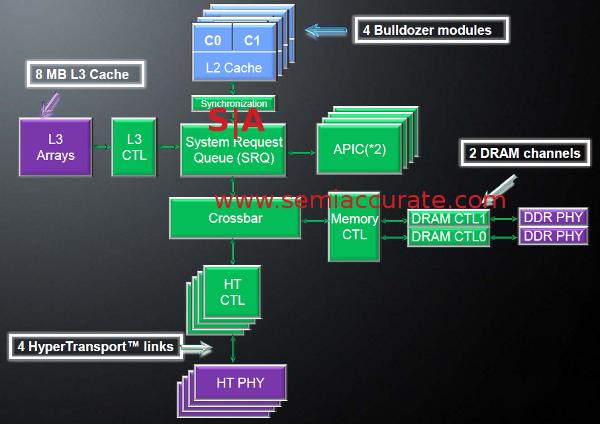
Northbridge in detail
The heart of the northbridge is the SRQ and Crossbar, together, they make sure every bit that goes on and off the CPU gets to the right place at the right time. The SRQ takes inputs from the cores, L3 cache and APICs, and makes sure nothing steps on the next request. Interestingly, it not only takes requests from the local cores, but also from remote cores via HT links.
Although it may not look like it in the diagram, if a request comes in from a remote CPU for data on locally attached memory, the SRQ will arbitrate this request, along with local requests, in whatever order AMD has deemed correct. All of these bits flow through the crossbar, something that is basically a big switch. Given how AMD broke the parts out, it looks like the crossbar is pretty ‘dumb’, all the intelligence is in the SRQ.
In multi-socket systems, this should theoretically allow quite a bit more efficiency and scaling, if the SRQ is even nominally aware of memory addresses owned locally and remotely, it can easily skip the bandwidth consuming requests to the local memory controller for addresses that are obviously not local. With luck, this will ease much of the socket scaling problems of the early K8 and K10h cores by eliminating some cache coherency traffic.
One interesting footnote here, if you take a look at the size of the uncore in Bulldozer and Intel’s Sandy Bridge, you can see that the AMD method takes a larger percentage of the die than Intel’s ring bus. How well both scale up, and what the latencies are for both schemes will have to wait until someone does head to head server benchmarks with multiple socket systems. That said, Intel’s tradeoff seems to put more of the on-chip interconnects in metal layers.
Bulldozer has two new memory controllers capable of running DDR3/1866 natively. They support unbuffered, registered, and Load Reduced DIMMs (LR-DIMMs) at 1.50, 1.35 and 1.25V. LR-DIMMs and 1.25V memory are just starting to hit the price sheets, so it looks like all of the goodies should be available in the near future. In addition to the new specs, this new controller is much more aggressive in power savings. It is heavily clock gated, and can slow down both to save power and to lower temps if something goes wrong. The list of tricks that it can pull is quite long, and this should pay dividends in the server space for light loads.
The DDR3 controllers are 72-bits wide for ECC protection, as is the L3 cache. That cache can be up to 8MB, and is physically split in to four chunks, but is seen as one block. All of addresses have the same latency unlike Sandy Bridge in which latency depends on the number of ring stops. The L3 can be partitioned to serve as a cache for coherency traffic in multi-socket systems. Depending on need, a chunk of the cache can be set aside, and the memory controllers will only put coherency data there. When in this mode, it that chunk of cache is called the probe filter, something first seem in the Istanbul chip line.
Next up is the Hypertransport controller, slightly beefed up from the last generation AMD parts. In Bulldozer, there are four controllers, all 16-bits wide per direction, running at 6.4 gigatransfers/second. That translates to 12.8GBps per link, per direction, or 51.2GBps per direction per socket. Depending on the socket, AM3+, C32, or G34, some of these links may not be exposed, and some may not pass coherency data.
Those links can be split in to two 8-bit links, and in multi-die packages, Interlagos and Magny-Cours for older cores, they do just this. If you look at the four socket system diagrams, everything looks fully connected. Since the 16 core CPUs are two 8 core dies interconnected with HT links, there aren’t quite enough to make every die fully connected to every other die. You can see the diagram here, with the worst case scenario being one hop of latency. This is a classic trade-off of package pin counts for latency, but with an average diameter of 1.25 hops, it isn’t going to hobble the system.
The HT links all have CRC protection and can retry errors. Like the memory controllers, the HT links can also scale back to conserve power, something that isn’t new to AMD chips, but is more advanced this generation than the last. The take home message is that HT can scale width and frequency dynamically as needed, and do so more often than before.
Speaking of power management, Bulldozer brings AMD cores right up in to the modern age, taking things a bit farther than Llano did. If you read the Llano details, the best way to put it is that Bulldozer has the same features, digital power measurement mainly, but they were baked in from the start, rather than retrofitted to an existing core. This control is now extend to the uncore, something that Llano didn’t do much of, and every block is heavily clock gated in a more granular fashion.
Of the new tricks, the biggest one is called Max Turbo. The idea behind this mode is to allow individual cores to go above the maximum turbo allowed when there is TDP headroom. It works in conjunction with the core C6 (CC6) sleep mode. CC6 is where the lightly used modules flush their caches, save state to a special local chunk of memory, and then have their power shut off. No power means no leakage.
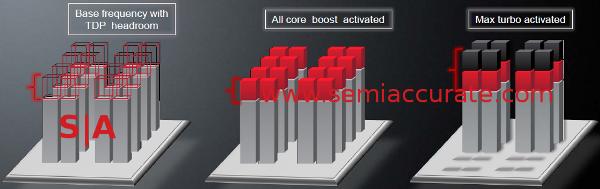
Max Turbo means half go faster
With turbo, current Bulldozer chips can scale all cores up 300MHz when TDP headroom permits. With Max Turbo, if half of the modules are in CC6, the remaining cores can clock up even more. Once again, current chips can clock up another 600MHz, so with Max Turbo enabled, a Bulldozer can boost it’s speed 900MHz. Some SKUs are limited to less frequency, but the cap for all of them seems to be 4.3GHz. Why?
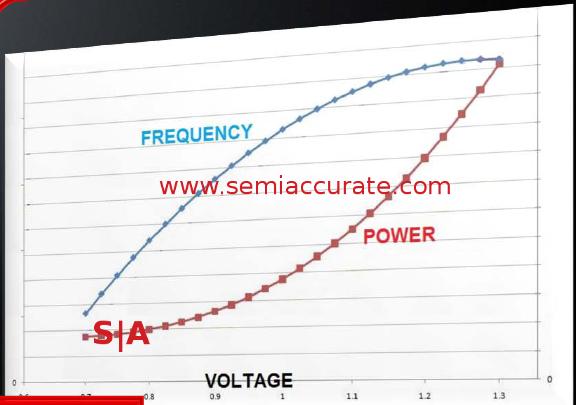
Note the leveling off of frequency
The diagram above shows off the problem with boosting frequency, increases tail off quickly with added power. After a while, you are basically burning wattage for almost no gain in performance. For the initial crop of Bulldozer parts, it looks like that curve flat spots at 4.3GHz, but as we have seen, these chips will clock to record levels if prodded appropriately.
One thing to note, the CC6 state is per module, a single core shares too many resources to put half of it in to CC6 with the other awake. It will be interesting to see what happens if the tools to manually control some of these features are released, there are a lot of knobs for geeks to play with on Bulldozer.
In the end, the uncore looks very familiar to the AMD uncores of the past. On a macro level, the biggest difference is that the northbridge now runs at a fixed frequency, 2.0 or 2.2GHz vs a multiple of the core clocks. Between this and a higher minimum core clock, 1.2 or 1.4GHz depending on exactly which model you are talking about, the complaints about wake time on older chips should be a thing of the past. Taken together, the uncore doesn’t look incredibly different, but as with the core, the devil is in the details. It is a completely new uncore, and nothing seems to be left untouched, but it is definitely evolutionary.S|A
64 Responses to “Bulldozer has an evolutionary uncore”
Trackbacks/Pingbacks
-
-
Oct 17, 2011
[...] Bulldozer has an evolutionary uncore @ SemiAccurate [...]
-
-
Oct 13, 2011
[...] Vorteile bringen. Wie genau das realsisiert wurde sagt man aber nicht. Charlie Deremjian von semiaccurate.com bringt eine interessante Idee ins Spiel: Statt – wie AMD es vorsieht – nur gesamte [...]
-
-
Oct 13, 2011
[...] Re: AMD – Bulldozer Chitchat Charlie has done a piece on BD Uncore: http://semiaccurate.com/2011/10/12/b…ionary-uncore/ [...]


Where’s Charlie’s take on Bulldozer FX reviews? At least Tom’s Hardware came up on their opinion on Bulldozer expectations.
Where the hell is the performance reviews by S/A? NV slip a little and S/A are all over them, AMD could release a retarded goose of a chip and nothing is said
Moronic fanboy rants from Charlie are old hat, where is the real scoop from the tech world now eh?
Yeah, it’s truly pathetic.
AMD probably knew that BD would be a disaster. If AMD gave up on the release of BD and started again they may have faced a shareholder lawsuit for not delivering on its prospectus. By actually doing the release AMD can blame the market, the economy, the software, the reviewers etc. Or in other words better to have the engineers look incompetent than management looking like frauds.
Not quite. Given the FX-8150 price, is was matched against the I5-2500/2600.
Benchmarks show that it can hold its own, except in single threaded applications. Here, it gets thoroughly spanked by Intel.
Is’nt it utterly crazy for a tech site not reporting any news of the benchmark of the Bulldozer 3-4 days after its launch? It is so biased in favour of AMD!
My deleted post about the anemic performance of Zambezi was from an article I read elsewhere. I guess URLs are verboten here.
Anyway, an ex AMD engineer said that the reason for the Bulldozer delay was due to mandatory use, by management, of automated design tools and drop hand optimizations to ensure cross-engineering (ATI-AMD).
Chips designers use hand-crafting for critical performance areas. Automated tools speed up the design process but cannot ensure maximum performance. In other words, the end result is a 20% bigger die and 20% slower.
So there you have it….
Ex AMD engineer blames automatic design tools for Bulldozer anemic performance.
This makes for an interesting read:
http://news.softpedia.com/news/Ex-AMD-Engineer-Blames-Bulldozer-s-Low-Performance-on-Lack-of-Fine-Tuning-227816.shtml
original story from Xbitlabs:
http://www.xbitlabs.com/news/cpu/display/20111013232215_Ex_AMD_Engineer_Explains_Bulldozer_Fiasco.html
Now, I wonder if AMD will do some hand optimization for the next batch of FX series CPUs (fx-8170). Seems like SoC designs are “sloths”.
I’m not sure they can afford to. AMD don’t have anywhere near the budget to spend designing chips that Intel do.
the first released revision is decent but sandy bridge is currently better (after how many updates/revisions) so you conclude bd is a failure. Look at phenom 9850.. Then phenom II x4 940.. look how the phenom II 985 ended up, lower voltage requirements, higher base frequencies.. Improved performance.
Th bd benchmarks show single int x16 performance is almost as fast as 980x which is why the heavily multi threaded apps puts it ahead of 2600k, but obviously the double x4 is barely faster than thuban and floating x8 is slightly slower than thuban.. Also it’s really a quad core.. Only 4 x86 decoders compared to 6 on thuban. Still both are half the speed of 2600k aside from the int x16 so yea single threaded app performance sucks
Piledriver is next revision and somewhere around 15% ipc improvement and lower power usage. There’s two new instruction sets for bd that need to be implemented in apps to make use of some improvements too.
And the whole uncore thing is showed on their slides.. Two socket G34 chips will be viewed as one processor to the os, gets 4 ht physical links instead of one and runs at 6.2gt/s instead of 5.4 gt/s on desktop version, and gets 16mb shared l3 cache.. So obviously the uncore does help as the article was saying.
Would I buy bd now? Nope.. Waste of money… As is the sandy bridge. I’ll wait to see piledriver and new intel offering that come out in a few months
I am confused, just got done reading Legit reviews, review and a few others, and the bottom line is that on single threaded application or Multi-threaded limited programs and games, Bulldozer did not perform as well due to the lack of IPC, when compared to phenom, and this is made worse only due to the huge latency disparage between each of the updated caches. It appears that they traded latency for more instructions or something of that sort. Also, there appears to be something going on with windows not handling “Bulldozers” threading capabilities correctly. I also suspect high leakage, due to the high voltage needed to increase speed. It seems if they tighten up their latency issues and increase their memory bandwidth, along with fixing their fab issues. That bulldozer can potentially increase performance by 30%-50%, from its current form, while reducing voltage. My “2 Cents”
However, if anyone knows of any investors, It would be great to know, due to my company providing a D506 memorandum for private investment. My company is a food safety focused company. That will go Global. We just need the capital to get it going.
Thanks,
Rafael
Ivy Bridge will be 1.5 Billion trannee’s, So Moore Engineering. Next Fx has 31 GB/s Transfer from HT ring & memory, yet Two G34 Socket gpu Have 84 Gb/s, so When Improved G34 Bulldoxer Comes along at 51 GB/s See from 2009 to 2012 Theres 20% increase & thats direct improvement from Top of line Server to Desktop.
By Time ~1974 pin Bulldozer is here, Instructions will be nestled into controllers, DDR3 Speed upped, pci-e3 shurley Will be prime player, & WEIRDO? DRASHEK
I think the real question is how does e design fit into the larger scheme of things? If Charlie is right about the Arm partnership, and Amd is of course moving towards a more integrated CPU and GPU, then does this design still hold up. Yes, it may be a Fermi, but keep in mind some of the moves Nvidia made in Fermi still hold up as right today, though the timing and execution weren’t all that good.
Don’t you guys think it’s funny that DJ Charlie Char hasn’t even tried to defend or spin all these bad reviews yet? Or that AMD MARKETING guy that frequents the forums (assuming he is still employed), maybe they even have their limits? It’s funny to hear, across forum land, that this cpu is ‘forward thinking’ and that software needs to catch up, etc. How long must one wait? I think the Smiths said it best, ‘How soon is now?’ ;)
Performance of the Intel’s P4 was all over the map. Once the developers used the new Intel compilers, which took advantage of the new instructions, performance stabilized and the angry hue and cry faded away.
Zambezi (from benchmark results), suffers from a number of weaknesses. I interpret them as follows (though I really like for Charlie to do a follow up on this).
Power Usage.
Yes, it has 2B transistors. Still, Load power consumption is above expectations, when we see a 45nm CPU use less than a 32nm Zambezi with power reducing tricks.
The CC6 state is a good idea, but I fear, ineffective at this point. The reason? Windows 7 scheduler is unaware of this state and the need for an application to be assigned cores within the same module. When cores are assigned all over the map, the chance for a module to enter the CC6 state is slim. Max Turbo, then, is impossible. Power usage remains high and that limits how much you can increase the CPU frequency.
Cache coherency is lost because the data must be fetched from different modules. The benefit of a shared cache for the two cores in the same module gets thrown out. This is a performance hit.
I also suspect fab process weakness, resulting in a lack of transistor uniformity. This leads to current leakage and the need to up the voltage/current to make up for it. This leads to Power consumption and heat.
IPC
Zambezi is short on this little gem and needs to be increased. Benchmarks clearly show this weakness (single threaded apps.) and Intel spanks Zambezi hard.
New Instructions
These were added to improve performance. At this point in time, there are no running applications that are aware and use these instructions.
The OS
Again, Win 7 and other OSes, need to understand the module/core design and the shared resources assigned to each for proper core assignment and avoid unnecessary cache flush/reload.
AMD failed here. I expected some Win 7 patch/driver update to allow it to become “Zambezi” aware. I also expected their internal tests to show this necessity.
Is Zambezi “forward thinking”? The answer is yes. Unfortunately, not all the ducks were lined up before launch.
On Windows 7 AMD can’t do anything about the scheduler.
This is up to Microsoft.
In the end we are back to the old hen and egg problem:
No one would implement the new features into their software until new CPUs are available.
No one will buy the new CPUs, because there is no software, which would use the new features.
In essence: Microsoft has to fix Windows, because their scheduler even mixes up the power saving strategies of current CPUs.
The multi thread capable software need to get an update to cope with AVX etc.
Games won’t gain from this, because they usually limp several generations of features behind. This is due the development time for engines. The games usually employ existing engines with minor tweaks. This reduces cost and development time, but also barrs them from employing the new features.
All true. However, Microsoft and AMD have worked closely before. The scheduler issue, can be fixed in 7. Microsoft, may not wish to do this as it will take away the “thunder” from Win 8.
I also expected the FX-8150 to compete against the I7 and not the I5.
Intel doesn’t have the problem with Windows 7 scheduler that AMD has.
AMD over the last 4 years has been working on BD and you are saying that AMD designed BD in such a way to be inefficient on all existing Windows OSs.
No AMD just implemented a bad design and is now in damage control.
The next 12 months will be ugly for AMD.
how slow are these guy’s on reporting about the EPIC fail of BD,
outperformed by a phenom 11 lolmfao
Bulldozer is broken and unfixable.
Hot, slow, late and unmanufacturable …
Thanks Charlie ^^
Ok, we get it. You are spiteful. How many accounts did you create to say your bullshit lines?
This thing is more broken than fermi. At least fermi still outperformed when it was late, hot, and broken. Oh and it was only about 6months late, not YEARS.
“This isn’t another Barcelona”
Sep 23 2011; Charlie Demerjian
Charlie, where are analysis of shitty performance and high power usage of new amd processors? bulldozzer flopped so much that it isnt even good for servers, who cares about this crap
The “King” is naked and has no balls nor schlom
Live in mother Russia and mighty cold. not sure what special computer do. please send me heat square to keep family warm to winter!
bd’s only good on paper.
bd’s bad in real world tests.
trying to compare 8150 with a 980x to make it look like having more value than an older generation intel system. this marketing would make sense if bd was released 2 years earlier.
with bd’s power cost, you’d be spending less, and having more performance with an intel system
no one can defend amd now.
“After a while, you are basically burning wattage for almost no gain in performance.”
The graph doesn’t show performance, it shows frequency, power, and voltage.
2 Billion transistor for 8 core in 4 modules. U Don’t Ohmn Me, 125 Watt. Looking Like AMD has Rock Bottom & up 50 cents already, Looking Better for 2X shot over year. Just depends if finfet means much. or worse. Ahso, pci-e3 question needs answer, then main can really shine. Tears inside, Burning to come on In, outa yesterday, latest fling.thisGIRL IS Sworn to Eternity. AMDspring. Sings sweetest Lovesong, Ever heard. Chickalettel.
Every Day getting closer, Going Faster Tan Rollar Coaster. Every String Seems little longer. every Day Love Little STronger. Shurely Come mY Way. My STory,Sad, Yet True. Took Crystal & Then Control Ran Around. Don’t Mess With Run Around Data, Sue. Shelac Travels Around, Murder & Valspar, Keep Away & Travel Around, Sheeeish Love U & Put You Down.
SongBirds Singing, Here RED’r will STay, While iPRAY. Linger….
drashek iINVENTED ITologist.
WEIRDO!
AMD used to be known for doing more with less.
Now they’re known as doing less with more.
Shame really, awful architecture.
how is it doing it with more, intel has way much more money and more people.
By “less with more” he obviously means, for example, 10% less single threaded performance than a 3.4 ghz phenom x4 when clocked at 4 ghz while using twice the wattage and twice the transistor count.
Bulldozer: Hot, Late, Slow.
Unfixable?
Bulldozer: 315mm^2, ~2 billion transistors
Sandy Bridge: 216 mm^2, 995 million transistors
…One of these is clearly more efficient…
“Bulldozer is this, BD is that, BD is AMAZING IN EVERY WAY!!!”
So why does it still suck anyway? Totally called it too… (Read: Exclusive: A look at the Bulldozer architecture) I mean it’s thirstier, slower, and clocked higher at stock! It almost looks like AMD pulled a Pentium 4! It’s just like centralization and wealth redistribution: it looks fantastic on paper and in academia, but in the real world it just fails miserably… Sorry AMD…
Heck, this thing is terrible when it comes to gaming as well! Guess I may need to reconsider that Trinity chip?
AMD has been very clear that this is a server chip, and as a server chip it is far from suckage. The consumer chip is piledriver which is out next year and supposedly has 10-15% more single threaded performance… Time will tell, but honestly, they increased the performance of their existing system and brought it up to core i5-2500 levels pretty much, which considering that they started this design 5 years ago, and managed to hit Intel’s performance despite all the delays… Think of where this would have been if it came out last year, like it was supposed to. Still, there’s a lot to be said for BD considering where they were with Stars, and what they’ve managed to accomplish.
Is BD reolutionary, yes? Is it great for you the consumer? Not particularly. Is it a failure? No, for it’s intended market, it’s freaking phenomenal.
Lastly, this is V1 of this silicon, V2 hits early next year, and they’re on a yearly tuning cadence from there on. I would expect you’ll find that there is a lot of headroom in this design they have yet to exploit, and it should allow them to be competitive with Intel, and superior in certain niche situations.
And really, given the sheer disparity between the two companies, that’s not half bad.
Zambezi is the client variant of Bulldozer. Interlagos is the server variant. Piledriver is simply an updated version of the Bulldozer architecture and will have its own client and server variants.
what makes bulldozer revolutionary? why is it any better for server? performance per watt or performance per $ matters there too.
If you look at the announcement of the new Titan computer Cray will be building for Oak Ridge National Labs, there is no mention of Intel anywhere. When someone spends 10s of millions of dollars on a computer, I’m sure they would care deeply about both performance per $ as well as performance per watt. Cray did announce a partnership with Intel a few years ago, so there has been plenty of time to work on Intel-based computers, but so far, there’s only mention of a computer in the 6-digit dollar range, and one in the 5-digit dollar range. If Intel were so superior for this type of computer, development would have been fast tracked, as it was for hybrid computers using NVIDIA GPUs. After all, Cray has access to the roadmaps for both Intel and AMD processors. I’m sure Intel would love to be featured in the fastest computer in the world!
I am wondering where the “Bulldozer is the biggest disappointment of the Year” headline is? I mean if Sandy Bridge launched without any Linux graphics drivers is cause enough to publish a similar headline then what does suckwad performance from AMD warrant.
apparently if you are Charlie D. Then it gets two op-Ed pieces of how glorious the architecture is….
The bias is truly pathetic….
True That
Next, can you find out from your AMD sources just WTF went wrong with BD’s design?
It doesn’t look like it is all the process to blame.
The performance is simply embarrassing. What happened to all the simulations and claims of something great?
I think BD’s design was for the server market. The client market (us) just got hammered.
There may be cache coherency issues due to Win 7 scheduler. I’ve seen some benchmarks were manually assigning a core improves the results… not all apps benefit, though.
Win 8 seems to be more “Bulldozer” aware. Still, this is just awful.
Bulldozer is very server-oriented, and while I had hoped for better performance, I am not surprised by the reviews today. When AMD first talked about BD they said explicitly that their goal was NOT to increase IPC. With a deeper pipeline and probably some bugs/idiosyncrasies in cache controllers (probably due to manufacturing, design or some of both), it’s not surprising that per-core performance is a little worse than Phenom II. Hopefully uptake will be good in the server market, and AMD can reinvest that high-margin profit into increasing per-thread performance.
Except we shouldn’t care about performance per “core”, but rather performance per socket, performance per watt, and performance per dollar.
And the performance per application.
Yes.
Performance per R&D invested.
Performance per distance processor shipped over time.
Performance per pins on chip
Performance per weight of processor (with and without packaging)
Performance per volume
Just PERFORMANCE PER EVERYTHING but PERFORMANCE itself.
Only Watt and Dollar have some meaning, the others are metrics just invented to make something crappy look better.
I’ve been with AMD all the way, very disappointed with Bulldozer. Still would NEVER switch to Intel. Not a fan boy, but I’d never trust companies that have actively been involved in dirty scandals.
Far Superior CPU Diagram than Article One. Two Way CHACHE Crossbar Is Well Documented here. Fantastic Improvement in Design Theory .Both Intel & AMD Are Breaking Thru Ice Cave into Completely new era. revolution In Engineering & Paradigmn Shift.
Notice Optimum voltage is 1.15. Similar to Phenom, yet phenom ,after years use would shift back up to natural 1.30 Voltage. Hopefully, Now 1.15 Voltage will be more permanent.
That is money saver of significance. 3000 Mhz/s core give basic cpu much needed Graphics potential, along with 51.2 GB/s per cpu HT Ring. Eveoluntionary is good term, ALL new In Step Up Way. Basic Frequency 66 Mhz/s More Than Average Bear. Memory Step up & SSD Natural, Hopping to Gleaming 900 Mhz/s When Blast furance Door Is Open. Hybrid natural. Mainboards Will have to Step Up to Capture Power.
Fios’ Head End or DocSys3 Cable Line in, Pleasure. Term: Not on All Models, probably means Fx series will be less & as Pin Count Expands, So will Feature list.
Basicly, Wait is Over for BULLDOZER. Thomas Stewart Raises Krinkly Ear & System has learning to Get on With. While year may take to get thru heavy G34 Wires to Stable Rev., Said & Done, Windows -=8=- should be strong Contender. Going Well beyond Anything Penguin Has Ever Been capable, for years to Come.
Hard Toe Race, With 2011 Pin next Month, Sandy bridge E less gpu compnent. Proving that One mountain is still unclimbable, cpgpu, for now, works, just dosn’t work right is upgrade for quality level. Two Way Chache Crossbar seems to have been conquered for first time & DAt Good. Oylimpic GOLD Being Polished, Medallions to Both Companies, Baton Is Is Starters Hand & Time Keeper About to Start Documentation of Gretess Sorts. Drashek Wheesing & Moving Ahead by Rolling States: Wait for ME, Got Softwre to Bind. Ultee’ Awaits ARM TV Monitors to Slip in with -=8=- Sync. theULTIMATE Experience In Cloud, Forming Tunnel of Circular Love.
After Path of Hurricane Dozer bridge Encounter, Soldiers will occupy Positions. from vantage to 3D ’11 testing to next level, Power Potporrri, NoBody Can STop them, Fet Fin being Black Card of Aces. Roth & Roam. Soon Never Ending Shuffle Will Have Jelled. Thats Clear Window of 4 years, with on end Transistors Packing House with Unbelivable crowds of Trannee’s. theCROWDS Cheer, Ultee’, Ultee’. Software Starts Pick Up Sticks Game & Instant computing Is Approaching Horizon, IT IS NEW DAWN.
Signed; Ultee’ Unit 4913-6446 Us, WorldWide consumption. Profits Enormous.
Are you the Time Cube guy?
No, he is one of those who led the initial development of Bulldozer, the most sane and reasonable one left to be specific!
Uhh okay… time to take your pills now.
Sheer genius! It’s amazing how much insight, critical analysis, and insider information can be crammed into what looks at first glance to be so much gibberish.
Carry on, TXS!
Can this be the reason why they ditched Dirk Meyer?
Thing is, even with all the built-in power saving tricks mentioned, power usage is horrible. So, either they are:
a) useless as tits on a bull
b) we have an AMD bumpgate
c) all of the above
BTW, Intel admits that its crossbar design is power hungry.
I’m looking forward to a future article about this power problem.
Yeah? Power use is horrible according to who?
Here is some reading for you:
http://www.hardwarecanucks.com/forum/hardware-canucks-reviews/47155-amd-bulldozer-fx-8150-processor-review-19.html
http://www.tweaktown.com/articles/4348/amd_fx_8150_am3_3_6ghz_bulldozer_cpu_review/index10.html
http://hardocp.com/article/2011/10/11/amd_bulldozer_fx8150_desktop_performance_review/9
http://www.anandtech.com/show/4955/the-bulldozer-review-amd-fx8150-tested/9
Well it’s not another Fermi to say but still got 2 billion transistors to feed!
Has no one dropped the bomb on Charlie that Bulldozer is pretty meh?
taken str8 from the weekly round-up: “Please note the lack of news on Bulldozer” :’) … Also, chuck went all out to tout Interlagos but _explicitly not_ Tesla in the article about Jaguar’s successor (no, I’m not talking about the car brand)
Good article, thanks Charlie!